Dr. Doug’s Primate Vet Suite
Introduction
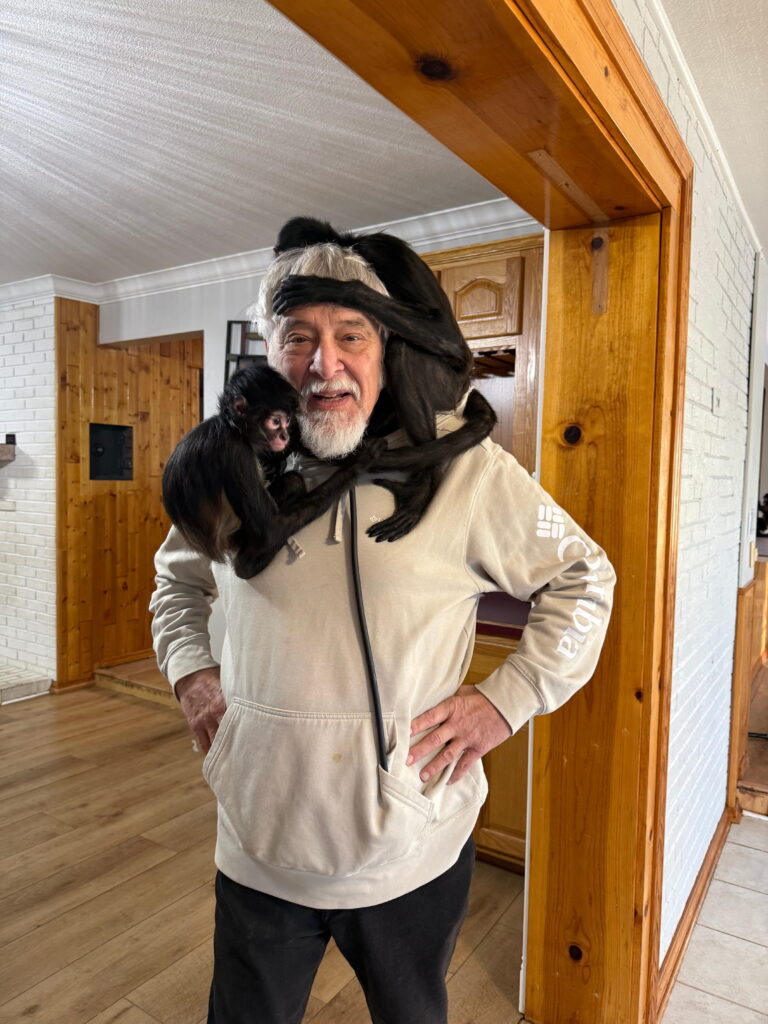
Dr. Doug Pernikoff has served over 45 years as a clinical veterinarian. Primates have always been a special interest for Dr. Doug, starting with over 1 year working as a keeper at Monkey Jungle in Goulds, Florida, under the tutelage of Mr. Frank DuMond, noted sanctuary owner and the first person to define the ‘fatted process’ in male squirrel monkeys as they come into breeding episodes.
Aside from his own historical experience keeping squirrel monkeys and marmosets/tamarins in his own home, he has worked & trained at Yerkes Primate Center during his veterinary college preceptorships, focusing on reproductive biology of great apes as well as general medicine with all species of primate held at the center.
Dr. Doug attended anthropology/primatology graduate studies at Washington University, St Louis, under Dr. Bob Sussman, noted primatologist whose focus involved lemurs in Madagascar and other New World primates in Central and South America.
Dr. Doug worked for Columbia University, NYC (Dr. Don Melnick), and the Smithsonian Institute (Dr. Wolf Dittus), trapping over 600 free-ranging toque macaques in Sri Lanka; anesthetizing, researching & collecting data for over 14 global studies. Not a single animal was lost during those anesthetic events in over 4.5 months of wild captures.
He created a fully innocuous darting system to successfully collect DNA sampling from free-ranging langurs in southern Malaysia in another field event. He successfully collected nearly 2 dozen samples in a single day, employing his novel dart system.
As a zoo veterinarian working at numerous zoos in the US (St. Louis Zoo, San Diego Zoo, San Antonio Zoo & the Fort Worth Zoo), he continued his clinical support of primates, assisting in the physical design and development of Great Ape Facilities at St. Louis and Fort Worth.
Dr. Doug served as IACUC Chairperson for the Bonobo Hope Initiative in Des Moines, Iowa, and continues to participate as a consultant to the group. This is a cursory overview of his training and experience with primates.
Additionally, he has consistently managed healthcare for private pet primates as well as sanctuary programs during his over 45 years in private practice up to the present time.
In the course of my pre-professional experiences, training, and as a licensed veterinarian, I have been fortunate to have been exposed to primates in research facilities, zoos, sanctuaries, and private homes, providing me a unique perspective across these many life events.
As a result, I am sharing some very personal ‘pearls of wisdom’ for private primate owners today. Please review and understand that these guidelines are to protect the primates you own and manage, as well as to protect your ownership opportunities as regulatory events are becoming more restrictive regarding private ownership of primates and other exotic animals.
This is not to say that I offer full support of these species in just any private setting. Rather, I apply my Veterinary Oath in offering my skills and knowledge to provide health and husbandry care of animals kept in captivity, ensuring their physical and mental well-being.
It is the responsibility of each and every person to establish ownership standards that protect their animals, as well as any humans who may come in contact with them.
Please understand that many diseases can spread between animals and humans (zoonoses), either by direct contact or indirectly through exposure to biomaterials like stool, urine, sputum, or airborne particles.
When any veterinarian suggests preventative healthcare such as vaccinations or diagnostics, please recognize their value for both you and your pets. Responsible ownership strengthens your ability to continue caring for these unique animals.
Please find the attachments herein as useful materials to guide your home programs. Be responsible and continue learning. I intend to offer regular discussions and references for the primate community.
Any questions can be directed to:
Email: dpernikoff@gmail.com
or through Texanne Teahan McBride, manager of Swing-a-Long Monkeys sanctuary program.
Thank you for your time and attention. Be safe and enjoy!
Respectfully,
Douglas S. Pernikoff, DVM, MBA